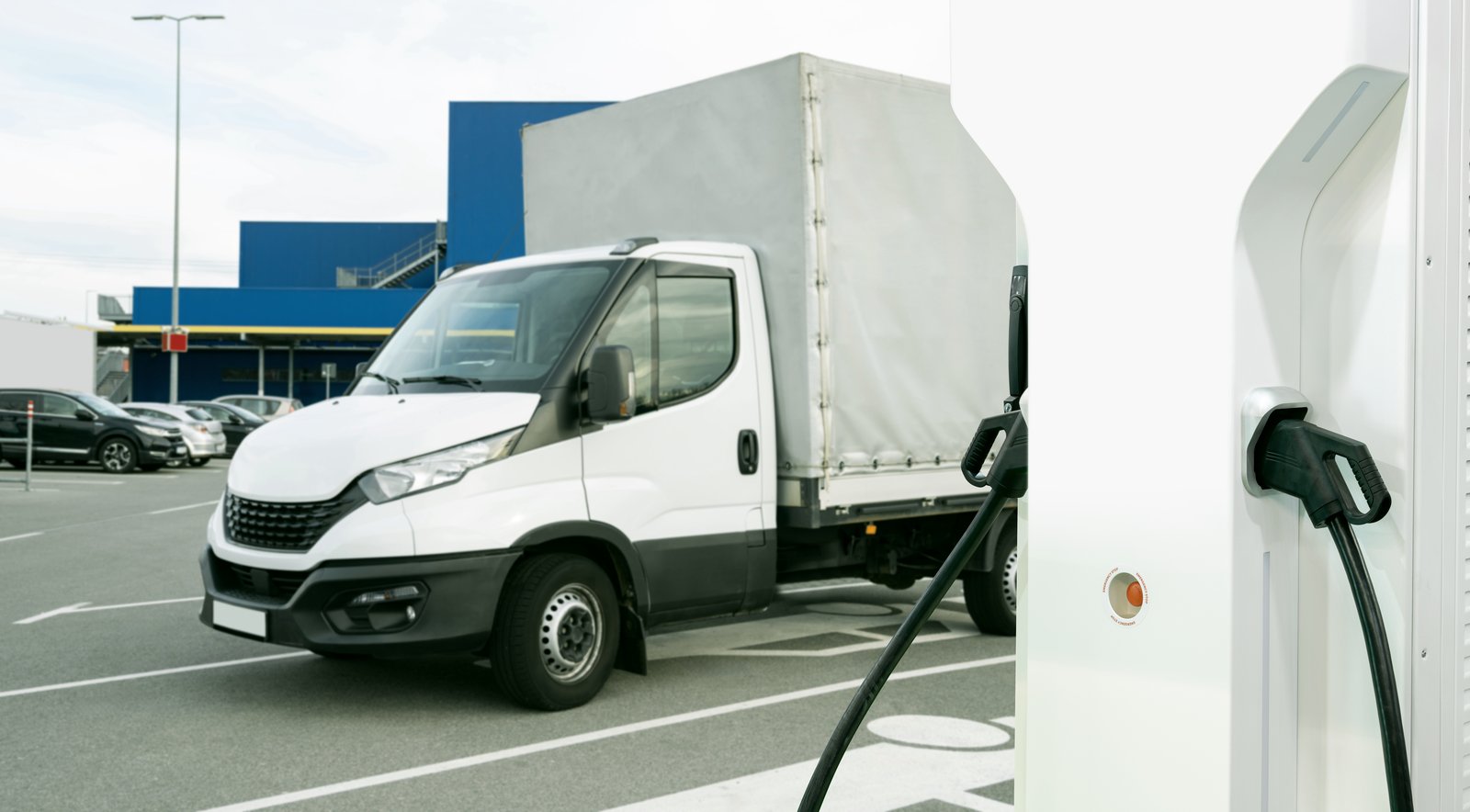
Electrically chargeable truck registrations in the EU rose 47.7% year on year in the first half of 2026, lifting market share from 3.6% to 4.8%, according to ACEA's H1 2026 commercial vehicle registration data. That growth is real, but the European Alternative Fuels Observatory counted only 373 operational heavy-duty charging locations and 2,405 charging points across the EU and EFTA as of April 2026, against roughly 6 million medium and heavy trucks on European roads. The fleet is electrifying faster than the charging network most of those trucks will actually use: the depot.
Most content about EV fleet adoption focuses on vehicle range, total cost of ownership, or public charging corridors for long-haul routes. The operational complexity that actually determines whether a logistics hub can run an electric fleet at all, scheduling a limited number of charge points against a larger number of vehicles and a fixed dock schedule, is a real search topic with almost no accessible explainer content.
What Charge Scheduling at a Hub Actually Involves
Depot charging is not simply plugging in overnight. A hub with, say, twelve chargers and thirty electric vehicles needs to decide which vehicle charges when, for how long, and in what order, so that every vehicle due out on a route the next morning has enough charge, without exceeding the site's available power draw or leaving a dock blocked by a vehicle mid-charge when it needs to be loaded.
Why Now
By mid-2025, at least 16 EU member states had grid connection queues for high-power charging hubs, with waits of 18 to 36 months described as routine, per analysis reported from EY and Eurelectric. A hub cannot simply add chargers to match fleet growth; the grid connection itself is frequently the binding constraint, which means the chargers a hub already has become a scarcer, more carefully scheduled resource rather than a problem that more hardware quickly solves.
The Structural Problem: Dock Scheduling Tools Don't Account for Charger-to-Vehicle Ratios
Most dock and yard scheduling tools were built for a world where every vehicle is interchangeable and ready whenever it is needed. An electric fleet breaks that assumption: a vehicle's readiness now depends on whether it has had enough charge time, which depends on how many other vehicles were competing for the same limited chargers overnight, which depends on the site's grid capacity. A scheduling tool that does not model charger availability as a constraint will schedule a route for a vehicle that is not actually charged enough to run it.
Five Steps to Hub-Level EV Charge Orchestration
- Capture charger and vehicle state in real time. Which chargers are occupied, which vehicles are plugged in, and each vehicle's current state of charge, captured continuously rather than assumed from a fixed overnight schedule.
- Match charging priority to the next day's route plan. A vehicle assigned to a longer route the next morning is prioritised for charge time over one assigned to a short local run, rather than charging on a strict first-plugged, first-charged basis.
- Schedule charge windows against the site's power constraint. The charging sequence is built to stay within the site's available power draw, rather than assuming every charger can run at full power simultaneously.
- Coordinate charging against the dock schedule. A vehicle mid-charge at a dock that is needed for loading is a conflict the schedule needs to resolve before it happens, not after a driver finds the dock blocked.
- Flag vehicles that will not reach sufficient charge in time. Where the charging sequence cannot get a vehicle to the charge level its assigned route needs, the system flags the conflict early enough for a route reassignment, rather than discovering the shortfall at departure.
How MIXMOVE HUB OS Supports EV Fleet Orchestration
MIXMOVE is an Intelligent Logistics Orchestration Platform. MIXMOVE HUB OS captures every handling and dock event at the hub, which extends naturally to charger and vehicle state as fleets electrify, since charge scheduling is fundamentally another resource-coordination problem layered on top of the same dock and yard operations HUB OS already orchestrates.
MIXMOVE operates as an orchestration layer above an existing yard or dock scheduling system, connecting through REST API, EDI, eFTI and webhooks, or as a standalone platform. A hub that is only beginning to electrify its fleet does not need its scheduling approach decided before the first vehicle arrives; the orchestration layer is designed to extend as charger-to-vehicle ratios change over time.
Charging Capacity Is a Scheduling Problem Before It Is a Hardware Problem
Grid connection queues mean most hubs cannot simply install more chargers to keep pace with fleet growth in the near term. The chargers already on site need to be scheduled against a changing mix of vehicles, routes and power constraints, which is a coordination problem, not a capital expenditure problem, and one that most dock and yard tools were never built to solve.
See how MIXMOVE coordinates EV charge scheduling alongside dock and yard operations. Request an Operations Review.
Frequently Asked Questions
Why is EV charging at logistics hubs more complicated than plugging in overnight?
Because a hub typically has fewer chargers than vehicles, and must schedule which vehicle charges when, in what order and within the site's power constraint, while also keeping charging vehicles from blocking docks needed for loading.
Why can't hubs just install more chargers to solve the problem?
Grid connection queues for high-power charging hubs ran 18 to 36 months in at least 16 EU member states as of mid-2025, so the grid connection itself, not available hardware, is frequently the binding constraint on expanding charging capacity.
Do standard dock and yard scheduling tools handle EV charge scheduling?
Most were not built to, since they assume every vehicle is interchangeable and ready whenever needed, an assumption that breaks once a vehicle's readiness depends on how much charge time it received relative to other vehicles competing for the same limited chargers.
How fast is the EU electric truck fleet actually growing?
Electrically chargeable truck registrations rose 47.7% year on year in H1 2026, per ACEA, lifting market share from 3.6% to 4.8% of new truck registrations, though charging infrastructure growth has not kept pace with that rate.