Rural last-mile delivery costs up to three times more than urban delivery, driven by longer transport chains, dispersed populations, and inconsistent infrastructure. This gap has persisted for years. It is now closing, not because rural geography has changed, but because the systems used to plan and execute delivery have changed.
Rural last-mile delivery is moving from a cost centre that logistics teams tolerate to a network problem they can actively solve. The evidence from live deployments is documented. The orchestration models are deployable today. What follows is a practical account of the challenges, the solutions, and how orchestration resolves the trade-off between speed and cost.
What Rural Last-Mile Delivery Actually Involves
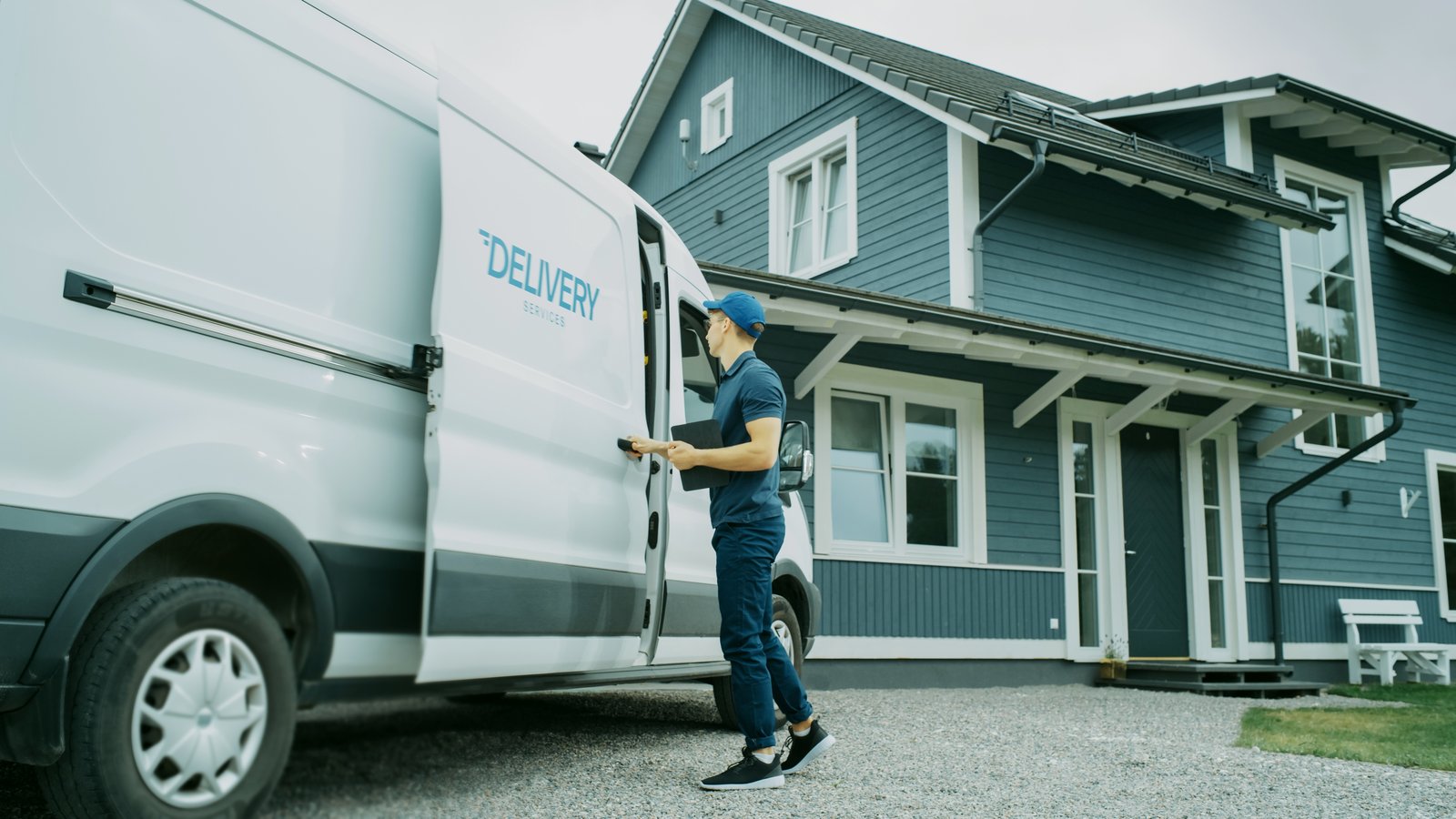
The World Economic Forum, in collaboration with Accenture, defines last-mile delivery as the transportation of goods from the final hub in the supply chain to their ultimate destination, whether that is a doorstep, a business, or a collection point. For traditional courier and parcel operators, this stretch typically covers the final 15 to 20 kilometres.
In rural contexts, that definition holds, but distances, address complexity, and delivery density work against it. A single rural drop can require a dozen or more miles of road travel, often on infrastructure never built for large delivery vans.
MIXMOVE’s own view is that the last mile in rural areas is not one delivery problem but three: reaching the address, justifying the cost of reaching it, and proving that it happened. All at once, and all documented.
A Problem That Predates E-Commerce
Rural distribution challenges are not new. What has changed is scale.
Academic research into European e-commerce distribution networks has found that rural markets differ from urban ones on nearly every operational dimension: lower population density, older demographics, weaker purchasing concentration, and, critically, a historic gap in delivery infrastructure investment.
That gap did not matter as much when rural retail ran through local shops. It matters considerably more now that rural households order online at rates approaching their urban counterparts. Eurostat data cited in the same research show that 56% of the rural European population purchased online at least once a year, up 10 percentage points over three years, compared with 62% for urban populations. The last mile has become a rural infrastructure question, not just a courier scheduling one.
Why Rural Delivery Is Under Pressure Now
Three structural pressures are converging on rural delivery networks simultaneously.
Consumer expectations have not softened for rural customers; only their patience has adapted. The World Economic Forum’s research shows that more than 70% of shoppers now value sustainable delivery options, and over 60% of e-shoppers generally prefer home delivery. Rural customers are more tolerant of longer windows than urban ones, but they still expect accuracy: a reliable estimate matters more than a fast one.
Labour and vehicle costs are rising against a backdrop of falling delivery density. Academic modelling of rural distribution networks found that as demand grows more dispersed, delivery routes become less dense and correspondingly less efficient per drop, pushing cost per parcel upward even as overall volume increases.
This is the speed-versus-cost trade-off at the centre of rural delivery. Historically, operators have had only two options: absorb the extra distance and cost to move faster, or slow down and consolidate to protect margin. Consolidation through local depots and orchestrated milk-runs removes the need to choose. Deliveries move through fewer, better-planned stops, so speed and cost improve together instead of trading off against each other.
Regulatory and reporting requirements are converging on logistics networks regardless of geography. Sustainability and emissions reporting obligations, including the Corporate Sustainability Reporting Directive and the extension of the EU Emissions Trading System to transport, apply to distribution networks whether they serve a capital city or a coastal village. Rural operators can no longer treat compliance as an urban-only concern.
Where Legacy Systems Run Out of Road
Transport management systems and warehouse management systems were built to optimise known networks: fixed depots, predictable postcodes, standard addressing. Rural delivery breaks each of those assumptions.
Visibility platforms can show where a vehicle is. They cannot decide where a rural depot should be located. They cannot reconcile an unregistered property name with a delivery manifest. They cannot generate the audit-grade documentation that emissions and compliance reporting increasingly demand.
Research from BCG and Deloitte on supply chain digitalisation has consistently identified the same structural gap: point solutions that observe operations without connecting execution data to network-level decisions leave a documentation and optimisation void between the depot and the boardroom. Until recently, no single platform connected physical execution to audit-grade compliance and network-level decisions in a single continuous data flow. That gap is precisely where rural delivery costs accumulate unseen.
How Orchestrated Rural Delivery Works
A modern, orchestrated approach to rural last-mile delivery typically follows five steps.
- Aggregate demand across postcodes. Instead of treating each rural address as an isolated delivery, the system consolidates demand across a wider geographic radius to identify viable delivery clusters.
- Select local depot or pickup locations. Using delivery volume, drive-time data, and existing local infrastructure, such as village shops or community locations, the system identifies where consolidation should happen before the final stretch.
- Optimise milk-run routing. A single vehicle serves multiple local depots rather than dozens of individual addresses, cutting drive time and fuel consumption per parcel.
- Manage exceptions in real time. Road closures, weather disruptions, and incomplete address data are dynamically flagged and rerouted rather than discovered on arrival.
- Generate proof of delivery and compliance documentation. Every drop, whether to a doorstep or a local depot, produces an audit-grade record that feeds directly into network-level and regulatory reporting.
The Layers Behind the Model
This process runs across two connected layers.
The execution layer handles the physical movement: vehicle routing, depot selection, and local delivery. The compliance layer captures execution data and structures it for network-level decision-making and regulatory reporting, including Scope 3 emissions reporting aligned with the ISO 14083 methodology.
Because the two layers share a single data flow rather than two disconnected systems, a change at the execution level, a rerouted milk-run, for instance, is reflected automatically in the compliance record rather than requiring separate reconciliation.
What the Evidence Shows
Third-party research supports the model’s underlying logic. World Economic Forum and Accenture modelling found that single-operator microhubs handling their own cross-docking and last-stretch delivery can lower carbon emissions by up to 93% and reduce local congestion by up to 11%, figures drawn from urban microhub deployments but directly applicable to rural depot consolidation. The same research found that white-label delivery models, in which one operator consolidates the final stretch across multiple retailers, cut total delivery costs by up to 51% when combined with lower-emission last-mile modes.
MIXMOVE’s own network reflects the same direction of travel. Across 35+ distribution companies in 20+ countries, MIXMOVE HUB OS has supported up to 80% fewer errors, up to 50% less warehouse space, and up to 58% in labour cost savings.
In a directly comparable network context, 3M reduced transport costs by 35% and CO₂ emissions by 50% through its MIXMOVE deployment, results confirmed publicly by Patrick Van De Vyver, former Head of EMEA Logistics Operations at 3M:
"By using the MIXMOVE software, 3M managed to reduce transport costs by 35% and CO₂ emissions by 50%."
— Patrick Van De Vyver, Former Head of EMEA Logistics Operations, 3M
Where MIXMOVE Fits
MIXMOVE HUB OS and MIXMOVE DI address the two halves of the rural delivery problem separately.
MIXMOVE HUB OS orchestrates execution: depot selection, milk-run routing, and local consolidation, maximising throughput from node to network. MIXMOVE DI structures the compliance side: audit-proof network intelligence, including CSRD and ETS2 reporting, built into the same data flow rather than reconciled after the fact. Both work alongside existing TMS and WMS systems as an orchestration layer, or as a standalone platform.
The Structural Advantage Compounds
The evidence from live rural deployments is clear. Orchestrated delivery is commercially deployable today, not a future capability. The structural advantage it creates compounds each quarter it remains in place.
Explore how MIXMOVE HUB OS orchestrates rural and last-mile delivery networks, or book a walkthrough of the MIXMOVE DI compliance layer for your Scope 3 reporting requirements.