
A wave of EU regulatory requirements is converging around 2026 and beyond. Complying with all of them simultaneously on fragmented operational data is where most logistics operations will struggle.
That is the first problem.
The second problem is where the responsibility sits. Compliance lands on legal and finance desks. The operational layer, where the data is actually created, is rarely part of the conversation until it is too late.

CSRD - The Omnibus I Directive
CSRD requires companies in scope to disclose Scope 3 emissions with sufficient rigour to withstand external assurance. For logistics operations, that raises the bar significantly. Carrier estimates and spend-based models are no longer sufficient. Auditors will look for activity-based data. Actual shipments, actual distances, real load factors, verified transport modes, structured in accordance with methodologies such as ISO 14083. The data has to come from the operation itself. Every workaround — carrier estimates, spend proxies, consolidated averages — leaves a gap that auditors will find.
One development needs addressing directly. The Omnibus I Directive, adopted in February 2026, significantly narrowed the CSRD scope — removing approximately 80% of previously in-scope companies and limiting mandatory sustainability reporting to large companies with more than 1,000 employees and annual turnover above €450 million. Some teams read that as relief. It is not.
The value chain cap introduced by Omnibus I limits what large enterprises can formally demand from smaller suppliers, but they can still request GHG emissions data under voluntary standards such as the VSME. The demand for verified transport emissions data does not stop at the regulatory boundary. It travels down the supply chain to any operator that wants to hold tier-1 contracts.
Two further details matter for operators managing complex structures. Companies listed in the EU that reported for the first time in 2025 are subject to transitional exemptions and do not need to report in 2026 or 2027. And where a company acquires subsidiaries that were not previously subject to the CSRD, a 24-month transition period applies before consolidated sustainability reporting is required. Both details affect logistics groups managing acquisitions or multi-entity structures.
The scope reduction changed the legal headcount. It did not change market expectations for the data.
ETS2
ETS2 extends carbon pricing to road transport. Trading begins in 2028, following a one-year delay confirmed by EU co-legislators in November 2025 and formalised in March 2026. Monitoring and reporting obligations are already active from 2025. From 2026, verified emissions reporting begins — the first concrete compliance obligation hitting fuel suppliers and regulated entities now, before trading opens. Every inefficient route, every partially loaded truck, every avoidable empty kilometre will carry a direct and measurable cost. Fill rate optimisation is no longer just an operational efficiency metric. It is a carbon-cost management strategy — and the planning obligations are now active.
ViDA
ViDA is often misunderstood in logistics discussions. It is not a freight regulation. It is a VAT reform focused on digital reporting and e-invoicing for cross-border B2B transactions in the EU. The package was formally adopted in March 2025. Its core obligation — mandatory e-invoicing and near real-time digital reporting for intra-EU transactions — applies from 1 July 2030.
The relevant implication for logistics is indirect but important. Transaction-level consistency between what physically moved and what is invoiced becomes harder to maintain when data is fragmented across transport execution systems and financial systems. That fragmentation becomes a risk when reporting requirements become more granular and time-sensitive.
Battery Passport
The Battery Regulation (EU) 2023/1542 introduces the digital battery passport. The requirements apply to EV batteries, LMT batteries, and industrial batteries with a capacity above 2 kWh that are placed on the EU market or put into service. They do not apply to every battery moving through a supply chain.
The implementation is phased. Labelling requirements apply from 2026. The QR code linking to the battery passport applies from 2027. The first obligations are therefore already active.
What this changes is the level of data expected around each battery. Companies will need more structured, traceable information about batteries throughout their lifecycles. For logistics, the impact is indirect but real. It creates pressure to maintain clear identification, traceability, and data continuity as goods move between systems, partners, and operational handovers.
Digital Product Passport
The Battery Passport covers one product category. The Ecodesign for Sustainable Products Regulation goes much further.
The EU Ecodesign for Sustainable Products Regulation is introducing the Digital Product Passport across a much wider range of product categories, with implementation launching in phases from 2026. The DPP will eventually apply to nearly all products sold in the EU. It marks a structural shift in what product data means across a supply chain — demanding traceable records for what each product is made of, how it moved through the chain, and where it ends up.
For logistics operations, the consequence is practical. As goods move between systems, partners, and operational handovers, the data continuity expected at each point increases. A logistics provider handling goods subject to DPP requirements is part of the evidence chain, whether or not it is the primary regulatory target.
CBAM
CBAM places a carbon cost on certain imported goods based on their embedded emissions. Full enforcement began in January 2026. It does not directly regulate transport emissions. That distinction matters.
The direct obligation concerns the carbon embedded in covered goods — cement, iron and steel, aluminium, fertilisers, electricity, and hydrogen — not the emissions generated by moving those goods through the supply chain. But as companies develop better visibility into the carbon intensity of imported goods, transport emissions are likely to come under more scrutiny as part of total landed cost, supply chain planning, and broader decarbonisation work.
For logistics, CBAM is not a direct transport regulation. It is a signal that carbon data is already inside commercial decision-making. Logistics operators handling CBAM-covered goods are already being asked by the importers they serve for emissions data.
EUDR
EUDR focuses on commodities linked to deforestation and requires traceability back to the origin of production, including geolocation data. It does not explicitly require chain-of-custody data at every logistics node. The regulation is not asking companies to track every warehouse event or transport milestone as a logistics platform might define traceability.
The regulation, however, does raise the bar for verifiable supply chain data. As companies move from supplier declarations to stronger traceability, logistics execution becomes part of the evidence around where goods came from, how they moved, and whether the data trail can be trusted. It is not the primary regulatory target. But it can become part of the proof.
The enforcement deadline for large and medium operators is 30 December 2026. Micro and small enterprises have until 30 June 2027.

Seven Regulations. One Common Demand.
Several regulations are scheduled to land at different points between 2026 and 2030. Different scopes. Different enforcement mechanisms. But one common pattern.
They all produce the same underlying demand: structured, traceable, and consistent data across the operation. A significant part of that data comes from day-to-day logistics execution. Not from reports or spreadsheets. Every warehouse movement, every transport order, every consolidation decision.
Logistics operations still run on fragmented infrastructure: warehouse systems, transport management, yard operations, carrier data, and financial records, all operating in parallel, with no single layer connecting them into a consistent, decision-ready dataset. As regulatory pressure increases, those gaps become more visible. And more expensive.
The risk is not just non-compliance. It is building compliance layers on top of weak operational data. That approach does not scale.
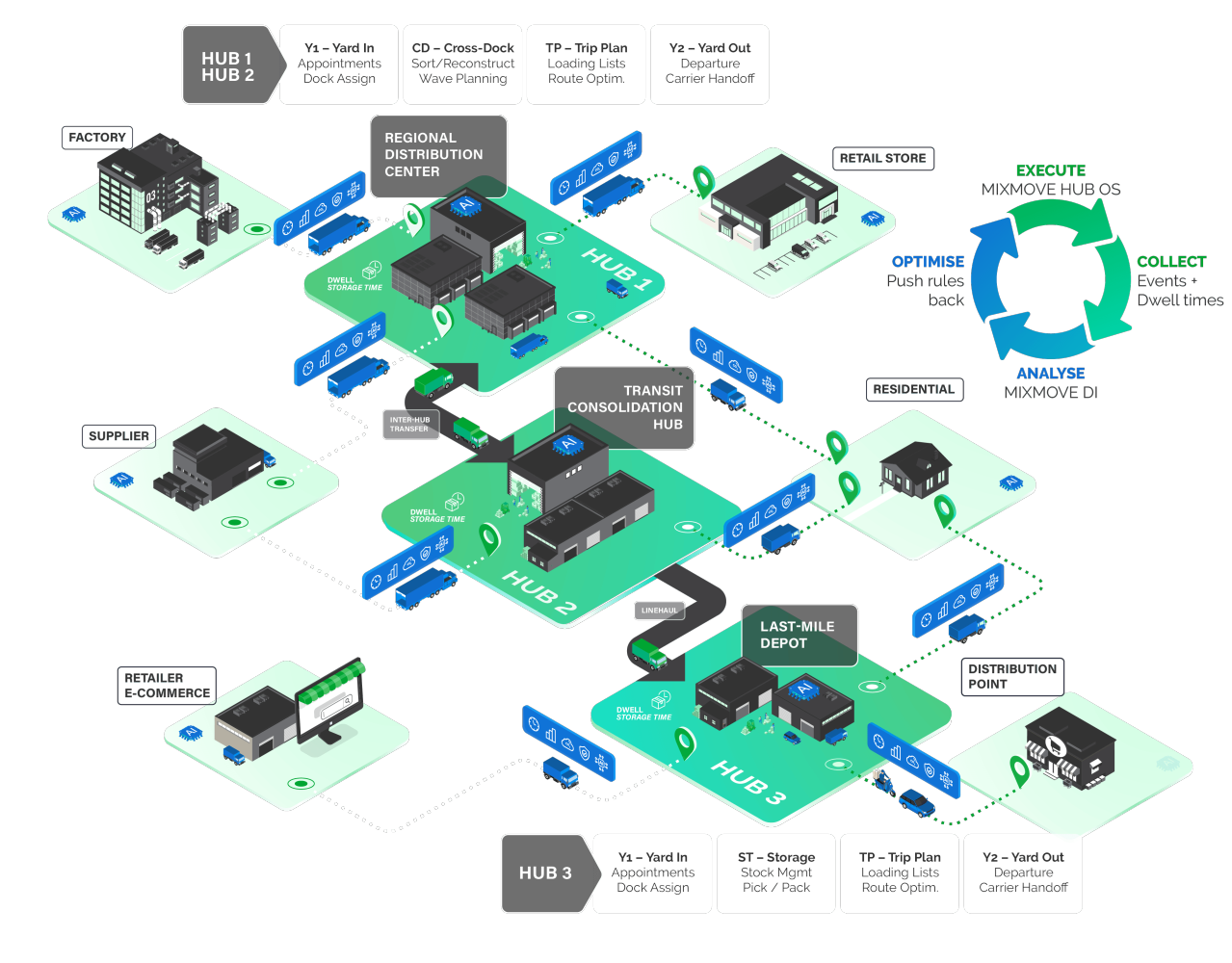
From Intelligent Execution to Decision Intelligence: The Operational Argument for Logistics Orchestration
Operators who treat regulatory compliance as an execution problem rather than a reporting project are in a stronger position. Not because they are more compliant, but because their data is already structured, consistent, and usable across different contexts. Operational control. Financial reconciliation. Regulatory reporting.
Many compliance tools sit at the end of the process, assembling data that should have been structured from the start. MIXMOVE sits at the layer where logistics data is created, not where it is reported. Its role is upstream: structuring operational data before it reaches compliance, finance, and network-level decisions. It connects transport planning and execution visibility into a single data flow. Every operational event becomes a compliance record, a financial control, and a network-level decision before the reporting cycle begins.
When that layer is built correctly, compliance becomes a natural extension of how the operation already runs, and the results are measurable. Transport fill rates reach up to 90%. Logistics costs fall by up to 35%. Warehouse space requirements drop by up to 50%. Freight audit cycles that used to take weeks run in hours, recovering 5 to 8% of total freight spend. Scope 3 reports are built from actual fill-rate data, structured to ISO 14083 — in a format CSRD auditors will accept, not one assembled after the fact from carrier estimates.
It is the opening of a regulatory window where gaps in operational data — unverified emissions, disconnected systems, manual processes — translate directly into compliance failures, financial exposure, and commercial risk.
The question is not whether companies will comply. It is how they will get there. By adding reporting layers on top of fragmented operations, or by fixing the operational foundations those reports depend on.
See how MIXMOVE turns operational data into audit-ready compliance. → www.mixmove.io/platform